
Grand National History: Famous Winners and Legendary Moments
 Available in US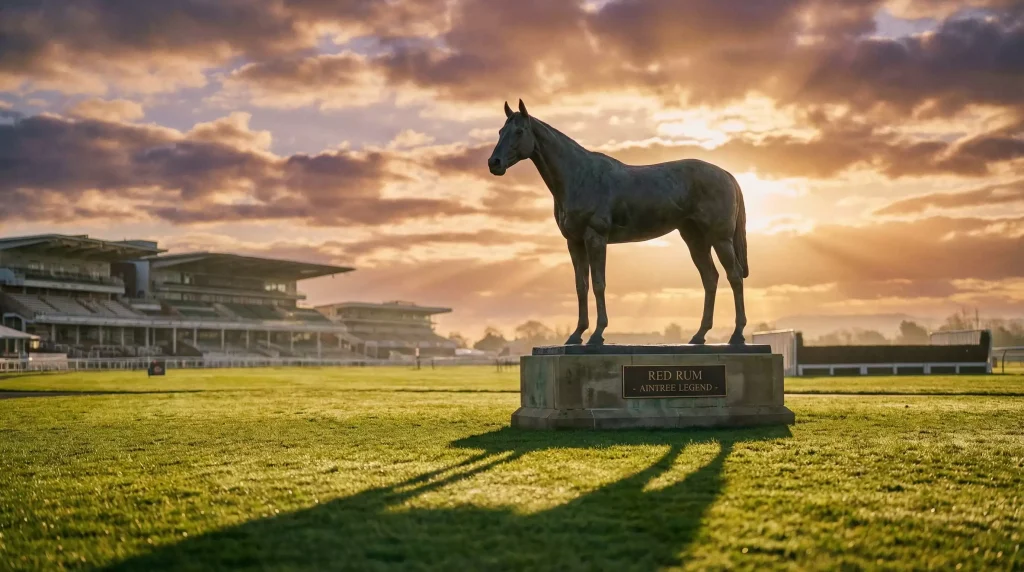
The Grand National has been running since 1839, and in those 180-plus years it has produced stories that transcend sport. Horses have become national heroes. Jockeys have achieved immortality. Single races have embedded themselves in collective memory, retold across generations who weren’t there to see them.
This isn’t accidental. The Grand National generates 700% more betting activity than the Cheltenham Gold Cup—its nearest rival in British jump racing—because it offers something beyond form analysis and odds calculations. It offers drama, unpredictability, and the persistent possibility that something genuinely remarkable might happen in the next four miles.
Understanding that history adds context to modern betting. As an Entain spokesperson put it: the Grand National is, without doubt, the greatest sporting event in the UK, capturing the imagination of friends and families up and down high streets and online. The horses running in 2026 compete against ghosts: Red Rum’s three victories, Tiger Roll’s back-to-back wins, the near-misses and heartbreaks that turned racing legend into permanent lore. Knowing what came before enriches the experience of watching what comes next.
Grand National History — More on this topic at grand national free bets.
The Horses That Became Household Names
Red Rum remains the definitive Grand National horse. Three victories—1973, 1974, and 1977—plus two second-place finishes established a record that may never be matched. Trained by Ginger McCain on the Southport sands, Red Rum recovered from a bone disease that should have ended his career to become the most famous racehorse in British history. His statue stands at Aintree, a permanent reminder of what sustained excellence at the National looks like.
Tiger Roll achieved what many thought impossible: consecutive wins in 2018 and 2019, the first horse to do so since Red Rum. Trained by Gordon Elliott and ridden both times by Davy Russell, Tiger Roll combined course knowledge with an ability to find extra reserves when needed. His diminutive size—small even by National Hunt standards—made the achievement more remarkable. He proved that sheer determination matters as much as physical advantage.
Aldaniti’s 1981 victory carries emotional weight beyond sport. Both horse and jockey, Bob Champion, overcame serious illness to compete—Champion having recovered from cancer, Aldaniti from career-threatening leg injuries. Their win became a story of human and equine resilience that captured public imagination far beyond racing circles. The film “Champions” brought their story to cinema audiences, cementing Aldaniti’s place in cultural memory.
Hedgehunter gave Ruby Walsh his second National victory in 2005, trained by Willie Mullins. Walsh had first won the race on Papillon in 2000, becoming one of very few jockeys to taste National success more than once in the modern era. The partnership illustrated how jockey experience and horse ability must align for National success.
More recently, Minella Times carried Rachael Blackmore to victory in 2021, making her the first female jockey to win the Grand National. That achievement came just weeks after she’d dominated the Cheltenham Festival, confirming her status as one of the sport’s leading riders regardless of gender. Minella Times’s victory marked a moment of change—proof that talent, not tradition, determines Grand National success.
Moments That Stopped the Nation
The 1967 Grand National produced the most famous finish in the race’s history. Foinavon, a 100/1 outsider so unfancied that three jockeys had turned down the ride, won after a pile-up at the 23rd fence brought down or stopped nearly the entire field. Only Foinavon, so far behind the leaders that he avoided the chaos, jumped the fence cleanly. The incident led to the fence being named after him—a permanent monument to one of racing’s most unlikely victories.
Devon Loch’s collapse in 1956 remains the National’s greatest mystery. Leading by five lengths approaching the run-in with the race seemingly won, the Queen Mother’s horse suddenly belly-flopped onto the turf, allowing ESB to pass and claim victory. No definitive explanation has ever emerged—cramp, a shadow on the ground, an attempted jump at a non-existent fence. The incident became shorthand for snatching defeat from the jaws of victory.
The void race of 1993 demonstrated that organisation can fail catastrophically. Two false starts, confused recall signals, and protesters on the course led to a race that was run but immediately declared void. Some horses completed the entire four miles before being told the result wouldn’t stand. The chaos prompted wholesale changes to starting procedures.
Auroras Encore’s 2013 victory at 66/1 proved the National retains capacity for genuine shock results. Ridden by Ryan Mania, the horse crept quietly through the field before powering clear after the last fence to win by nine lengths. The victory enriched bookmakers who’d laid the odds; it rewarded those few punters who’d backed a lightly weighted runner with limited recent form to recommend him.
Each memorable moment reinforces the same truth: the Grand National defies prediction. Form suggests; the fences decide.
Records That Still Stand
Red Rum’s three victories set the benchmark all others are measured against. No horse has won more than three times. Tiger Roll’s two consecutive wins represent the only back-to-back achievement since Red Rum managed it in 1973-74. The race’s attrition rate makes repeated success extraordinarily difficult—the toll on horses means few return at peak form year after year.
The fastest time belongs to Mr Frisk, who completed the course in 8 minutes 47.8 seconds in 1990. Notably, this came before safety modifications raised fences and modified drops, making direct comparison with modern times difficult. The course that Mr Frisk ran was subtly different from today’s.
The longest winning odds belong to Tipperary Tim, who won at 100/1 in 1928—and even then only because just two horses finished. Foinavon’s 1967 victory at 100/1 is often cited as the greatest shock, but technically ties the record rather than exceeding it. Multiple horses at 100/1 have won, each adding to the race’s reputation for unpredictability.
George Stevens holds the record for most jockey wins with five victories between 1856 and 1870—an era when the race was less competitive but no less dangerous. In the post-war period, Brian Fletcher’s three victories—Red Alligator in 1968, then Red Rum in 1973 and 1974—set the modern benchmark. Ruby Walsh later won twice, on Papillon in 2000 and Hedgehunter in 2005, confirming himself among the race’s elite riders.
See also Grand National Course Guide.
Why the Grand National Endures
Survey data confirms what observation suggests: 77% of those who bet on the Grand National consider it part of British culture. Not entertainment, not sport—culture. The race occupies space alongside events like Wimbledon and royal occasions, rituals that define national identity regardless of personal interest in the underlying activity.
The accessibility matters. You don’t need to understand racing to watch the Grand National. The drama is immediate: horses jumping enormous obstacles, the possibility of chaos at any fence, a winner emerging from unpredictability. Experts have no meaningful advantage over casual viewers. Everyone watching has roughly equal odds of witnessing something extraordinary.
That combination—history, accessibility, unpredictability—explains why the Grand National endures while other races fade from public attention. Each running adds to accumulated legend. Each winner joins a lineage stretching back nearly two centuries. Betting on the Grand National means participating in something larger than a single afternoon’s racing.
History Entertains—Betting Should Too
The Grand National’s history makes compelling viewing regardless of whether you’ve placed a bet. If gambling stops enhancing the experience and starts dominating it, step back. The race will run again next year; the stories will continue accumulating.
Support is available if needed. GambleAware and the National Gambling Helpline provide free, confidential advice. All UK-licensed bookmakers require customers to be 18+, and terms apply to every bet and offer.
