
Grand National Odds Explained: How Betting Odds Work
 Available in US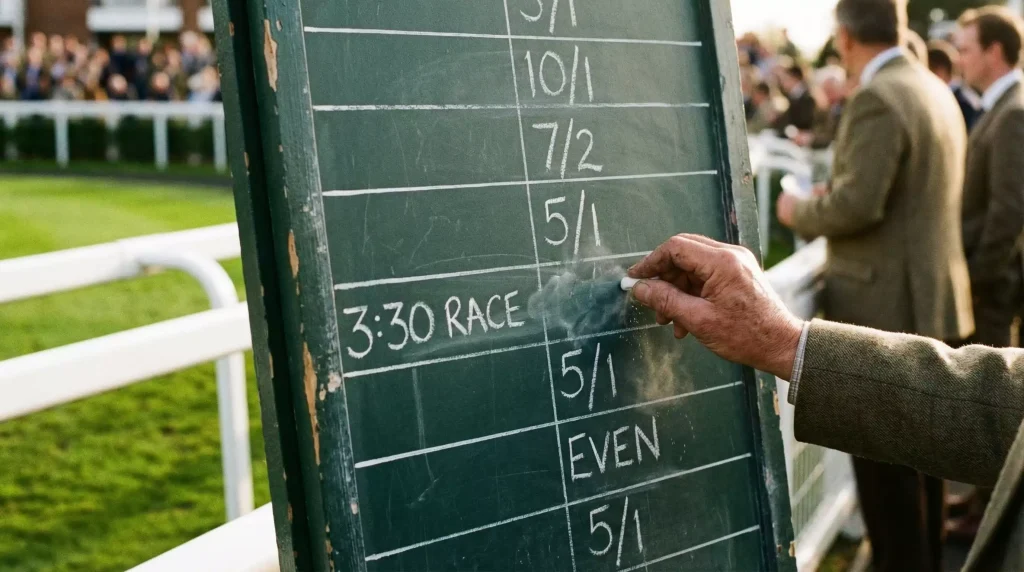
Odds represent probability expressed as potential profit—a simple concept that confuses more bettors than it should. According to a 2026 YouGov survey, 43% of those planning to bet on the Grand National use odds as a primary factor in choosing their horse. Yet understanding what those odds actually mean, how they translate to payouts, and why they shift requires knowledge that isn’t always obvious.
This guide breaks down betting odds from first principles. Whether you’re seeing fractional quotes like 10/1 or decimal displays like 11.00, the underlying logic remains consistent. Once you grasp that logic, the numbers stop being mysterious and start being useful—tools for comparing value rather than symbols to ignore while picking based on name or colours.
The Grand National market operates differently from shorter races. With 34 runners, even the favourite trades at substantial odds, and the full range extends from single figures to triple-digit longshots. Getting your head around odds decoded across that entire spectrum helps you make informed decisions rather than hopeful ones.
Grand National Odds Explained — More on this topic at grand national free bets.
Fractional Odds: The Traditional Format
British horse racing traditionally displays odds as fractions: 5/1, 10/1, 33/1, and so on. The first number represents potential profit; the second represents the stake required to earn that profit. At 5/1, you profit £5 for every £1 staked. At 10/1, you profit £10 for every £1. The logic scales linearly—a £5 bet at 10/1 returns £50 profit plus your original £5 stake.
Shorter prices work identically. At 2/1, you profit £2 for every £1. At evens (1/1), you double your money. Odds-on prices like 1/2 or 4/5 indicate favouritism: at 1/2, you profit £1 for every £2 staked. The lower the fraction, the shorter the price, the more likely the bookmaker considers that outcome.
Grand National odds rarely dip below 5/1 even for the favourite, reflecting the genuine uncertainty of the race. Most runners trade between 10/1 and 50/1, with genuine outsiders stretching to 100/1 or beyond. Survey data shows 43% of Grand National bettors stake less than £10—at those levels, fractional odds make calculating returns straightforward without a calculator.
The fractions themselves contain embedded meaning. A horse at 8/1 implies roughly an 11% chance of winning (100 divided by 9, the total of both numbers plus stake return). At 20/1, that drops to about 5%. These implied probabilities help compare horses across the field, though bookmaker margins mean the combined probabilities always exceed 100%. That overround represents the bookmaker’s edge.
Fractional odds suit small stakes and straightforward bets. They become cumbersome for complex calculations—accumulators, each-way bets with fractional place terms, or comparing value across multiple bookmakers. For those purposes, decimal odds offer a cleaner format.
Decimal Odds: The Alternative Display
Decimal odds express the total return—stake plus profit—as a single number. Odds of 11.00 mean a £1 bet returns £11 total: £10 profit plus the £1 stake. The decimal format dominates betting exchanges like Betfair and appeals to bettors who prefer multiplying rather than calculating fractions.
Converting between formats is straightforward. To turn fractional odds into decimal, divide the first number by the second and add one. So 10/1 becomes (10 ÷ 1) + 1 = 11.00. And 5/2 becomes (5 ÷ 2) + 1 = 3.50. Reversing the process: subtract one from the decimal, then express as a fraction. Decimal 6.00 becomes 5/1; decimal 2.50 becomes 6/4 or, more commonly, 3/2.
Decimal odds simplify accumulator calculations. Multiply the decimal prices of each selection together, then multiply by your stake. Four horses at 3.00, 4.00, 5.00, and 6.00 produce a combined multiplier of 360.00—a £1 accumulator returns £360. Trying the same calculation with fractional odds requires considerably more arithmetic.
Most UK bookmakers let you switch between fractional and decimal display in your account settings. Neither format is inherently better; they express identical information differently. Choose whichever you find easier to read, and don’t let format unfamiliarity prevent you from comparing odds across different platforms.
Calculating Your Potential Returns
A win bet pays out if your horse finishes first. The calculation multiplies your stake by the odds. A £5 bet at 12/1 returns £60 profit plus your £5 stake—£65 total. At decimal odds of 13.00, the same bet returns £5 × 13.00 = £65 total. Both expressions describe identical outcomes.
Each-way betting splits your stake into two parts: half on the win, half on the place. If your horse wins, both parts pay out—the win portion at full odds, the place portion at a fraction of those odds (typically 1/4 or 1/5 for the Grand National). If your horse places but doesn’t win, only the place portion pays.
Consider a £10 each-way bet at 20/1 with 1/4 odds for places. That’s actually £20 total: £10 to win, £10 to place. If the horse wins, the win portion returns £200 profit plus £10 stake. The place portion returns (20/1 × 1/4 = 5/1) £50 profit plus £10 stake. Total return: £270. If the horse finishes second, third, or fourth without winning, you collect only the place portion: £60 total from your £20 outlay—a £40 profit.
Free bets typically return profit only, not the stake. A £10 free bet at 10/1 returns £100, not £110. This distinction matters when calculating expected value from sign-up offers. Stake Not Returned (SNR) bets are worth less than equivalent cash stakes at the same odds—approximately the profit margin implied by the odds themselves.
Online betting slips calculate returns automatically, but understanding the underlying maths prevents nasty surprises. Check the slip before confirming: does it show the return you expected? If not, something in the odds, stake, or bet type differs from your assumption.
See also Can I Use Free Bets on the Grand National?
Why Odds Change Before the Race
Odds aren’t fixed predictions—they’re prices that respond to supply and demand. When money flows onto a horse, bookmakers shorten the odds to limit their liability. When a horse attracts little interest, odds drift longer to tempt punters. The morning price and the starting price often differ substantially.
Significant market moves carry information. A horse shortening from 20/1 to 12/1 suggests informed money arriving—stables backing their own runner, professional gamblers acting on private knowledge, or syndicates moving as a coordinated group. Watching these moves can reveal confidence levels that public form doesn’t capture.
Drifters—horses whose odds lengthen as race time approaches—often signal problems. Perhaps the ground has changed unfavourably, or the horse didn’t travel well, or whispers from the yard suggest it’s not right. The market aggregates thousands of individual assessments into a single price, and when that price moves against a horse, the aggregated opinion has shifted.
Best Odds Guaranteed protections insulate you from adverse moves. If you back a horse at 14/1 and it wins at a starting price of 20/1, BOG pays the higher price. This asymmetry favours early betting: you can lock in a price knowing you’ll receive any improvement while remaining protected against your selection shortening.
Understanding Odds Isn’t Beating Them
Knowing how odds work makes you a more informed bettor, not a guaranteed winner. The bookmaker’s margin exists precisely because they employ people who understand probability better than most punters. Treat betting as entertainment with a cost, not a system to beat.
Set limits before you bet. If gambling becomes stressful or compulsive, organisations like GambleAware and the National Gambling Helpline offer free, confidential support. All UK-licensed bookmakers operate 18+ only. Terms and conditions apply to every offer and market.
